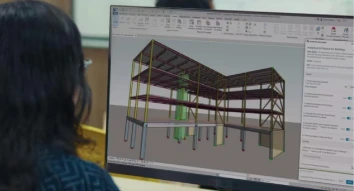
Designed for working professionals, engineering graduates, and diploma holders, the Quantity Surveying course from MEP Dubai provides comprehensive training in cost management. The syllabus of the QS course includes both theoretical and practical training in using modern technology and tools to estimate cost and quantities for MEP and construction projects. Build your future in cost estimation with quantity surveying training.
4.7 Ratings
Overview of Quantity Surveying
Quantity surveying plays an important role in construction projects in managing costs and ensuring maximum resource utilisation. Our quantity surveying estimation course aims to provide hands-on training in project cost control. Contribute to the financial success of construction projects with our QS courses in Dubai.
What you’ll learn in the course?
You will learn the preparation of BOQ, rate analysis, project budgeting, financial tracking, cost estimation, material quantity calculations, interpretation of construction drawings, and much more with QS training.
The course will give you expertise in handling software tools like AutoCAD, Primavera, PlanSwift, and Microsoft Excel.
Quantity Surveying Course Syllabus
The Quantity Surveying Course syllabus covers the following:
Have an overview of quantity surveying and its importance in the construction industry
Understand the reading and interpretation of drawings such as plans, elevations, and sections.
Learn the basics of methods used for measurement and the tools used for estimation
Study the steps involved in a construction project and the key terminologies used.
Know the main components of construction costing, including material cost, labor cost, equipment cost, and profit.
Become familiar with the various types of estimates, including preliminary, detailed, and approximate.
Understand the cost calculation for civil works such as brickwork, concrete, woodwork, steelwork, earthwork, etc.
Learn about cost control techniques and the impact on costs when changes are made to the design.
Practical training
Understand the step-by-step procedure to be followed for rate analysis, and know the sources for collecting relevant data needed for analyzing rates
Learn about material consumption calculation per unit and finding the differences between the market rate and the analyzed rate.
Have an overview of advanced tools, like ARRAY, ALIGN, FILLET, OFFSET, EXPLODE, etc.
Find out how to adjust rates depending on the location
Study the usage of the relevant software tools for rate analysis.
Practical training for rate analysis for concrete work, flooring work, and brick work.
Have an overview of what BOQ is, its purpose, its types, and its importance in construction projects.
Learn how to prepare BOQ for civil works, finishing works, and MEP works.
Study how to prepare BOQs in the pre-contract and post-contract stages.
Understand the methods and units of measurement.
Practical training in the preparation of BOQ, writing the descriptions in BOQ, and trade-wise BOQ preparation.
Become familiar with the various types of technical drawings.
Understand drawing scales, units, title blocks, elevations, dimensions, levels, and sections
Learn about grid lines and reference systems. Study the interpretation of structural details like footings, beams, columns, and slabs.
Find out how to coordinate architectural and structural drawings
Practical training in reading building plans, interpreting MEP layouts, and identifying structural components
Understand the purpose of tendering in construction projects and the various types of tenders
Learn about the various components of tender documents, including BOQ and drawings
Study how to prepare the tender BOQ and the procedure to be followed for submitting the bid.
Know the tender opening process and post-tender negotiations
Practical training in preparing a tender
Have an overview of what quality control is and how it is different from quality assurance.
Learn about material quality checks and the testing of construction materials
Study the standards to be followed for quality control and how to handle non-conformance reports
Know the documentation and the preparation of quality records
Practical training in identifying quality issues
Understand the types of construction risks, including financial, technical, contractual, environmental, and safety risks
Study the techniques used for identifying risks and risk assessment.
Learn about cost risks, time-related risks, and dispute risks. Study the allocation of risks in a construction project
Find out how to change visual styles, view models from different angles, apply basic materials, and create simple models.
Find out how to use contingency planning in estimation and value engineering for reducing risks.
Practical sessions in risk analysis for a construction project
Understand what construction reporting is and its importance in cost control.
Know the various types of quality surveying reports, including cost, progress, cash flow, and variation reports
Find out how to make budget reporting, actual cost reporting, and Monthly Cost Value Reconciliation. Learn the techniques for forecasting the final cost of the project.
Learn about the preparation of Interim Payment Applications. Study the tracking of variations, and the making of the essential changes
Practical training in preparing a monthly cost report
The Importance of Quantity Surveying Course Training Certification
The Quantity Surveying certification is important for professionals in the construction industry as it helps in moving their careers to the next level by opening doors to multiple job opportunities.
Why learn a QS certification course?
To gain skills in cost estimation
To learn how to prepare BOQ
To get knowledge in tendering
To reduce financial risks and control the cost of the project
Industry Demand for Skilled QS Professionals in Dubai
The demand is high because of the rapid growth in the construction industry
Multiple job opportunities available in the State
The demand for QS professionals in high-rise projects in Dubai
Quantity Surveying Course Training Outcome
1. After completing the QS courses in Dubai, trainees will get industry-ready skills essential for managing costs in the construction industry.
2. The quantity surveying program helps participants to advance their careers and increase their earning potential.
3. You gain practical skills in using modern, updated tools to make precise cost estimation.
4. On completing the quantity surveyor course, you will get a valuable certificate that
Has international recognition
Proves the skills and knowledge you gained from the course
Improves your job opportunities in Dubai and abroad
Adds an added element to your CV and makes you stand out in the competitive job market
Why Choose MEP Dubai for Quantity Surveying Course Classes in Dubai?
MEP Dubai is popular for its short-term technical courses designed for working professionals, and one of their best courses is their Quantity Surveying Estimation Course. Why should you choose it?
Comprehensive syllabus including all concepts
Experienced trainers with updated knowledge
Flexible schedules to suit working professionals
Career support and placement guidance
Industry-recognized certificate
FAQs
A QS course is a training program to equip the trainees with the skills to manage the costs and finances of a construction project efficiently.
The best AutoCAD course for beginners includes practical sessions in its curriculum and equips you with both theoretical and practical knowledge.
The syllabus includes all concepts from basic introduction to the complex topics, including BOQ, rate analysis, cost calculation, risk management, etc.
Yes, it is very useful in Dubai because of the booming construction industry, which demands many talented professionals with knowledge in quantity surveying and estimation.
The duration of the course varies depending on factors like the intensity of the syllabus. However, a short-term course lasts for a few weeks, and an advanced course may last for about 4-6 months.
Civil engineering graduates and diploma holders, professionals working in the construction industry, building contractors, foremen, and supervisors can join the course.
Having More Questions?
If you have any unanswered questions you can contact the
support team 24/7.
I am a fresh civil engineering graduate. I had only theoretical knowledge. The QS course from MEP Dubai provided me with practical skills that helped me enter the industry with confidence.
Helpful?
Fatima R.
1 day ago
I loved the course so much. The trainers were excellent. They explained complex topics beautifully. I would recommend it to anyone interested in cost and quantity estimation
Helpful?
Mohammed T.
4 day ago
The course taught me the use of software tools. It helped me to complete my work precisely and quickly. Thanks, MEP Dubai.
This course is one of the MEP Certification Courses and gives thorough
training in the design of water supply, distribution, and drainage systems. It
equips you with the skills to build cost-effective and water-saving plumbing
designs.
The firefighting design course covers practical and theoretical aspects
of the design of
fire protection system. It is perfect for MEP engineers interested in designing
safe,
efficient, and effective firefighting systems.
This course from MEP Training Institute Dubai provides comprehensive
knowledge of
residential, industrial, and commercial heating, ventilation, and air conditioning
systems. It offers practical training in load calculations, the selection of
chillers
and AHUs, and the use of software tools for HVAC design.







 Plumbing Design Course